4 Formative Books in My Life


Recently, someone asked me to name some of the most formative books in my life.
After some thought, I compiled a partial list. In this post, I will provide you with four titles, along with summaries and relevant quotations.
Before I give you these titles, let me offer a few explanations.
Four caveats
- To call a book formative is to recognize its role in the slow work of my transformation into the likeness of Jesus Christ. These books challenged assumptions, clarified convictions, and opened new vistas of understanding. By God’s grace, they continue to be instrumental in shaping me intellectually and spiritually.
- Although these books are transformative for me, the same may not be true for you for several reasons. Among those reasons are personal makeup, life circumstances, and willingness and desire to grow in Christ. We are all different, and the Lord deals with us according to our uniqueness and individual needs.
- My list of formative books continues to grow. I hope the same is true for you.
- Let me also say, the Bible is the all-time most formative library of books for me. Reading, meditating, and obeying its message each day aligns our hearts, minds, and lives with God’s ‘Story.’
Now, let’s look at some of those titles.
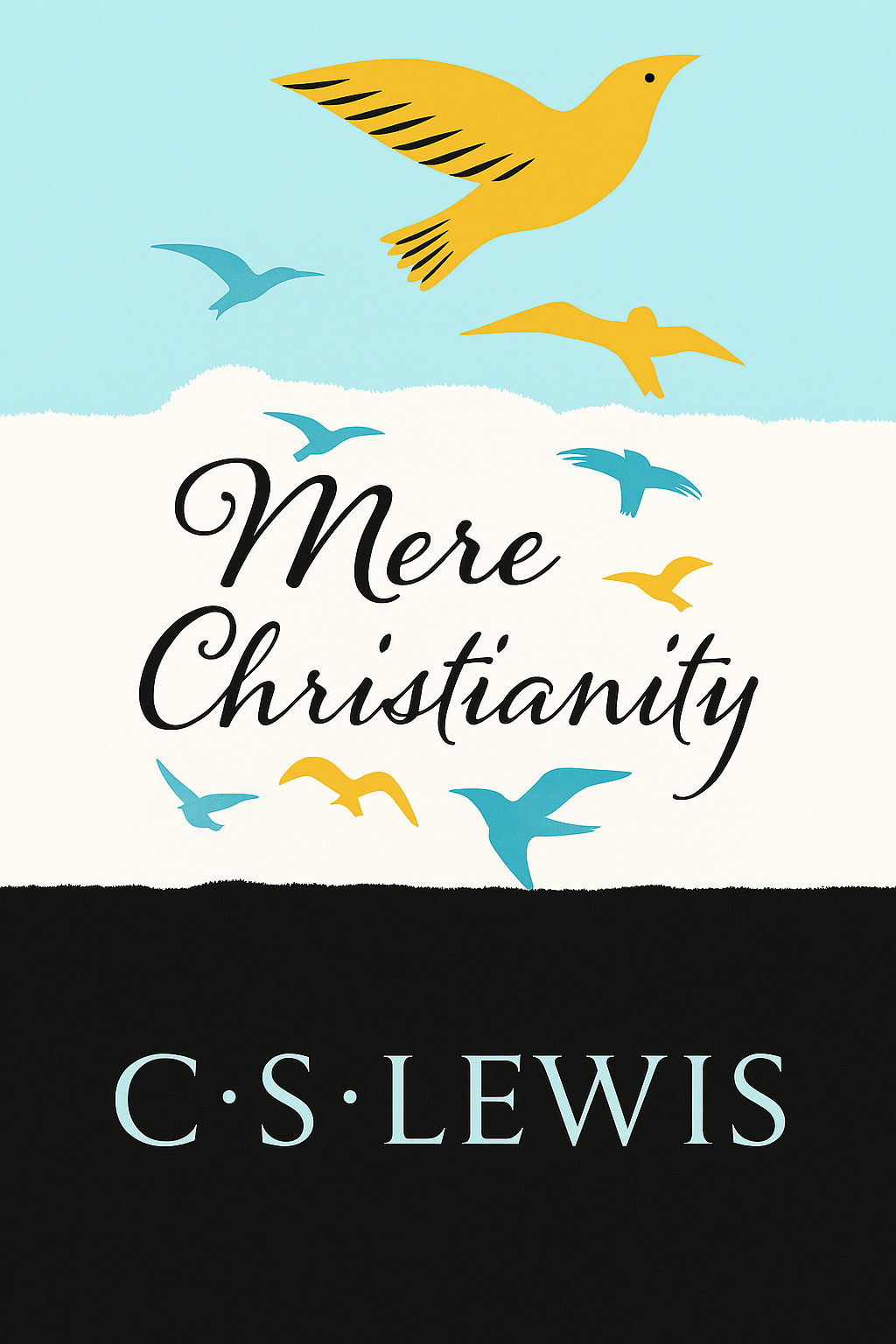
Mere Christianity by C. S. Lewis
I begin with this title because I read it soon after becoming a Christian. Finding it was great timing; I do not recall how. I was a third-year university student, confronted with questions internally and challenges externally.
The book comprises a series of talks on the BBC during World War II. Its four divisions are:
- Right and wrong as a clue to the meaning of the universe (i.e., a universal moral law points to a divine source),
- What Christians believe (i.e., the nature of God, the person of Jesus Christ, and the significance of his death and resurrection),
- Christian behavior (i.e., love, faith, forgiveness, and hope), and
- Beyond personality: or first steps in the doctrine of the Trinity (including our spiritual formation).
Lewis’s writing is accessible, reasoned, and compelling. Here is a sample about the claims of Jesus:
I am trying here to prevent anyone saying the really foolish thing that people often say about Him: “I’m ready to accept Jesus as a great moral teacher, but I don’t accept His claim to be God.” That is the one thing we must not say. A man who was merely a man and said the sort of things Jesus said would not be a great moral teacher. He would either be a lunatic—on a level with the man who says he is a poached egg—or else he would be the Devil of Hell. You must make your choice. Either this man was, and is, the Son of God: or else a madman or something worse. You can shut Him up for a fool, you can spit at Him and kill Him as a demon; or you can fall at His feet and call Him Lord and God. But let us not come with any patronising nonsense about His being a great human teacher. He has not left that open to us. He did not intend to.[1]
I also read similar books, such as John Stott’s Basic Christianity and Paul Little’s Know What You Believe, but for me, Mere Christianity is the one that stands out.

The God Who Is There by Francis A. Schaeffer
Someone pointed me to this title early in my Christian life, but I could not get into it. A couple of years later, I picked it up again, and this time I was ready.
Published in 1968, Schaeffer identifies and confronts the cultural shift away from absolute truth in the modern West—an absolute truth rooted in “the God who is there.”
The evidence of this drift is even more apparent now than it was fifty years ago. Instead of truth, there is ‘my truth’ – whatever that means; a host of alleged alternatives displace biological male and female distinctions; and then there is everyone doing whatever is ‘right’ in their own eyes, which replaces the universal morality that distinguishes right from wrong.
Schaeffer also points out that this fragmentation allows our culture to banish Christianity from the public forum as an irrelevant private truth (‘your truth’). He argues that historical Christianity presents a coherent and comprehensive worldview that speaks to all areas of life. He stresses that this worldview and its God-rooted truth are not just a matter of religion; instead, they encompass all of reality and all of life. That leads to his call for followers of Jesus to engage thoughtfully with contemporary culture, defending the faith with grace, wisdom, and intellectual rigor.
As I write this, I feel a pull to reread his book.

The New Testament Documents: Are They Reliable? by F. F. Bruce
Why read the Bible? How can you trust it?
As a young believer, Bruce’s little book (120 pages) introduced me to the wealth of manuscript evidence for the New Testament (NT), surpassing that of other ancient writings. In that regard, he writes:
The evidence for our New Testament writings is ever so much greater than the evidence for many writings of classical authors, the authenticity of which no one dreams of questioning.[2]
He also addressed common challenges regarding the authenticity, dating, transmission, and historical accuracy of the NT. In addition, Bruce discusses the formation of the canon (i.e., what books are included in the NT), the role of archaeology, and the confirmation of biblical people, places, and events by non-Christian sources. He emphasizes that the New Testament should be approached with the same historical criteria applied to other ancient documents.
For me, this book demonstrated that the NT is reliable, and the Christian faith is rooted in verifiable history.
 Man’s Search for Meaning by Viktor E. Frankl
Who said that only Christian books are formative?
This book is largely autobiographical, covering Frankl’s experiences as a Jewish prisoner in a Nazi concentration camp, and tracing the development of logotherapy.
As a prisoner, he witnessed many people going through the successive stages of shock, apathy, and disillusionment. He argues that the will to find meaning is humanity’s deepest drive. Even in the most dehumanizing conditions, individuals can choose their attitude and find purpose through work, love, or even suffering.
Frankl argues that meaning is not invented but discovered, and that even in the darkest circumstances, one retains the freedom to choose one’s attitude. Frankl’s message is timeless: life has meaning under all conditions, and this meaning is the key to endurance and dignity.
With that in mind, one quote that has stayed with me is:
He who has a why to live can bear with almost any how.[3]
This book was a wholesome challenge to me to live life with a God-honoring purpose.
Summing up
As I reflect on these four books and recall what I gained from them, I discern their influence in the formation of my purpose over the years, which is
to equip and encourage people to become more like Jesus Christ, and to live all of life with God-honoring competence and joy.
There are more books to summarize and bring to your attention, and I will do that periodically.
In the meantime, I want to hear about the books that have been formative in your life and why they have had such an impact. I look forward to hearing from you. You can write to me using this link.
FORWARD TO the next post in the series on formative books
BACK TO Truth, the Irish, Love, and John
Notes:
[1] C. S. Lewis, Mere Christianity (New York, NY: Macmillan, 1943), 55-56.
[3] F. F. Bruce, The New Testament Documents: Are They Reliable? 5th ed. (Downers Grove, IL: Inter-Varsity, 1960), 15.
[3]Viktor E. Frankl, Man’s Search for Meaning (New York, NY: Simon & Schuster, 1959), 12.
Photo credit: Depositphotos
Click "yes" to receive resource-rich newsletters.
Helpful resources provided to 'living theology' subscribers.
YES!