The Woman, the Seed, and the Serpent

Larry King, a longtime CNN talk show host, was once asked who he would most want to interview if he could choose anyone from all of history. He said,
“Jesus Christ.”
The questioner pressed,
“And what would you like to ask Him?”
King replied,
“I would like to ask Him if He was indeed virgin-born. The answer to that question would define history for me.”
Virgins are not in the habit of giving birth to children. This is basic biology. No human has ever been conceived without a human father.
Then Mary comes on the scene.
Mary
Mary is a young Jewish woman expecting a child—and she is a virgin. According to the Gospel records, her pregnancy occurred without a human father.
Luke records the event as follows:
And the angel answered and said to her, “The Holy Spirit will come upon you, and the power of the Highest will overshadow you; therefore, also, that Holy One who is to be born will be called the Son of God.” (Luke 1:35)
What took place was a conception that defies the course of nature.
Mary had to brave scandal, shame, and scorn, but she knew that she was immersed in a historic God-moment.
But Mary kept all these things and pondered them in her heart. (2:19)
The Seed
As Mary struggled to come to terms with what was happening, did the first messianic promise of the Old Testament (Genesis 3:15) snag her attention?
And I will put enmity
Between you and the woman,
And between your seed and her Seed;
He shall bruise your head,
And you shall bruise His heel.
A liberator would come and crush the head of the serpent. The fatal blow will be delivered by One described as “the seed of the woman.” No father is mentioned. A virgin birth is intimated.
Mary surely pondered this text. Was she participating in the fulfillment of this prophecy? Was she carrying in her womb the One who would overthrow the power of evil?
It is a stunning thought.
Genesis 3:15 must have made a powerful impact upon Mary. It would be no surprise if it became her life-verse.
Jesus was born and grew up in the home of Joseph and Mary. Several other children were later born to them (Mark 3:31-32).
We can only surmise that, at some point, Jesus’ parents must have spoken to him of the circumstances surrounding his birth. Joseph was not his father but his stepfather. Mary, his mother, had conceived and given birth while still a virgin.
Did they also point to the Old Testament prophecy of a virgin that would conceive and bear a Son (Isaiah 7:14)? Did they read to Him the promise about “the seed of the woman” who would defeat Satan? When did Jesus come to the startling realization that “the woman” was his mother and the “seed” was Himself?
Fascinating conversations must have taken place in the home of the carpenter of Nazareth. They were sheltering a great secret: the seed of the woman lived under their roof. Joseph and Mary were raising the promised Liberator.
The Woman
Fast forward to John 2.
Jesus and His mother are now at a wedding in a town called Cana. When his mother informs him that the wine had run out, Jesus addresses her in a surprising way. He calls her “Woman.”
In normal Aramaic conversation, a son would almost never address his own mother this way. The word is respectful, but strikingly distant and formal. The translators of the 1984 NIV Bible, sensing the awkwardness, softened it to “Dear woman.” Problem solved.
The Greek text, however, simply says— “Woman.”
Later at the cross, Jesus again addresses his mother as “Woman.” (John 19:26).
Why does John twice record this unusual manner of speaking to his mother? Could this be a deliberate echo of Genesis, just as in the opening words of John’s Gospel?
I think it is very likely.
Christ probably used that word intentionally to draw a connection to the Biblical prophecy that speaks of “the woman” and her seed.
Jesus said to her (John 2:4),
“Woman, what does your concern have to do with Me? My hour has not yet come.”
This might best be understood as Jesus speaking in a way only his mother would understand. In effect, He seems to say,
“Mother, the wine of joy ran out a long time ago in the Garden of Eden. The hour is coming—and now is—when joy will be restored. It will happen through My death. The cross will not be defeat; it will be the crushing of the serpent’s head. The curse will be lifted. Genesis 3:15 is about to be fulfilled.”
At the wedding and at the cross, our Lord spoke a word that echoed the Bible’s very first promise of a deliverer—the One who is the Seed of the Woman would reverse the damage caused by Adam’s sin.
The Serpent
Three times in John’s Gospel, Jesus refers to Satan as “the prince of this world” (12:31; 14:30; 16:11). The adversary occupies a position of authority on planet Earth gained through deception.
Indeed, the Bible declares in 1 John 5:19 that
the whole world lies in the power of the evil one.
But this is about to change.
The seed of the woman has arrived, and this false prince was about to be dethroned.
Listen to Christ's own words on the way to the cross:
Now is the judgment of this world; now the ruler of this world will be cast out. (John 12:31)
A regime change was about to take place.
Paul describes this event:
And having disarmed the powers and authorities, he made a public spectacle of them, triumphing over them by the cross. (Colossians 2:15)
“Made a public spectacle” refers to the Roman custom of parading conquered enemies in chains through the streets. That is what happened at the cross.
The head of the Serpent was crushed.
And when Christ finishes implementing the complete victory won at Calvary, everything will be made new.
Charles Spurgeon once wrote:
Cheer up now you faint-hearted warrior. Not only has Christ traveled the road, but He has slain your enemies. Do you dread sin? He nailed it to His cross. Do you fear death? He has been the death of Death. Are you afraid of hell? He has barred it against the... [entrance] of any of His children... Whatever foes may be before the Christians, they are all overcome.
What does the coming of the virgin-born Christ into this world mean?
It means the seed of the woman has come to reverse the calamity of the Fall.
It means evil has an expiry date.
It means we have a glorious hope.
Christmas is not merely cute and cozy.
Christmas is God’s D-Day.
It is when God invaded enemy-occupied territory, bringing hope to a lost world.
Indeed, that is worth celebrating!
FORWARD TO the next post in this Advent series
BACK TO This Is For You: Good News of Great Joy
Jurgen’s Bio: Dr. Jurgen Schulz is a Canadian missionary from Victoria, B.C., who, along with his wife Wendy, has served in Bolivia for over forty years. He is currently an instructor at the Seminario Bíblico Evangélico in the Andean city of La Paz, Bolivia.
Last year, Jurgen was granted an honorary doctorate by the Universidad Nuestro Pacto International. You can read more about the ministries of Jurgen and Wendy at this link on the MSC website.
Jurgen has written several books, including What Story Have We Fallen Into?, which you can purchase at Amazon, Barnes & Noble, Indigo, and other stores.
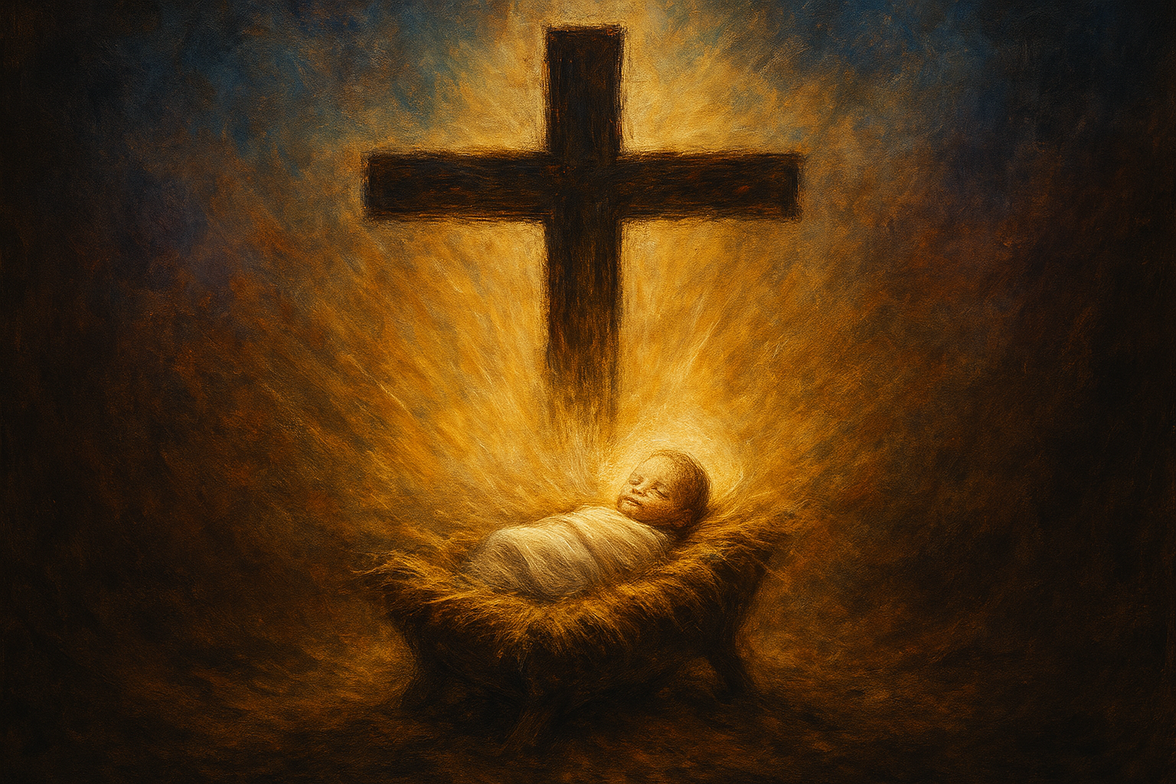
Image credit: John B. MacDonald, © 2025, using specific prompts for illustration purposes in conjunction with A.I.
Click "yes" to receive resource-rich newsletters.
Helpful resources provided to 'living theology' subscribers.
YES!