A Map to Guide You to Forgiveness


I wisely start with a map.
(J. R. R. Tolkien)[1]
When in unfamiliar territory, it is valuable—if not necessary—to have a good map.
If you know where you are, an accurate map can show you a route to your destination.
In the previous post, we identified the desired destination of the journey of forgiveness. In this post, you will receive a map for that journey.
Some limitations of maps
Maps are helpful, but they have limitations. Here are four.
1. A map is only a representation of the real terrain.
For example, a globe of the Earth may be the size of a soccer ball. As such, the globe is a representation or model of the Earth, not the Earth itself. In the same way, a map is only a representation of the ground to be covered on a journey.
A good map may have different colors to signify what is forest, or desert, or river. It may also have lines to indicate different roads or elevations. But those colors and lines are not actual forests, deserts, rivers, or roads.
These statements are obvious, but need to be stated: a map is simply a representation of the real terrain.
2. A map does not dictate the route you take.
Depending on where you begin, your journey may have any number of paths to reach your destination. For instance, one route may be a wide, flat freeway; another a steep, rocky trail.
Our ‘map’ for the journey of forgiveness should not be read as if there is only one precise road that can be travelled. For instance, the pathway to reconciliation for Joseph’s brothers included their father’s pain, a regional famine, and an enigmatic Egyptian ruler (Genesis 42-45).
David’s passage included confrontation by the prophet Nathan and the death of a child (2 Samuel 12). The prodigal son’s return involved hardships that flowed from his own lifestyle (Luke 15).
The ‘map’ of forgiveness should not be read as a mechanical or invariable formula. This ‘map’ depicts the markers to be covered between the reality of broken relationships and the destination of reconciliation. It does not dictate a specific route.
3. Using a map requires some basic skills.
In addition to cartographic symbols and scales, reading a map properly demands the skills of orienting yourself, charting a route, and staying on course.
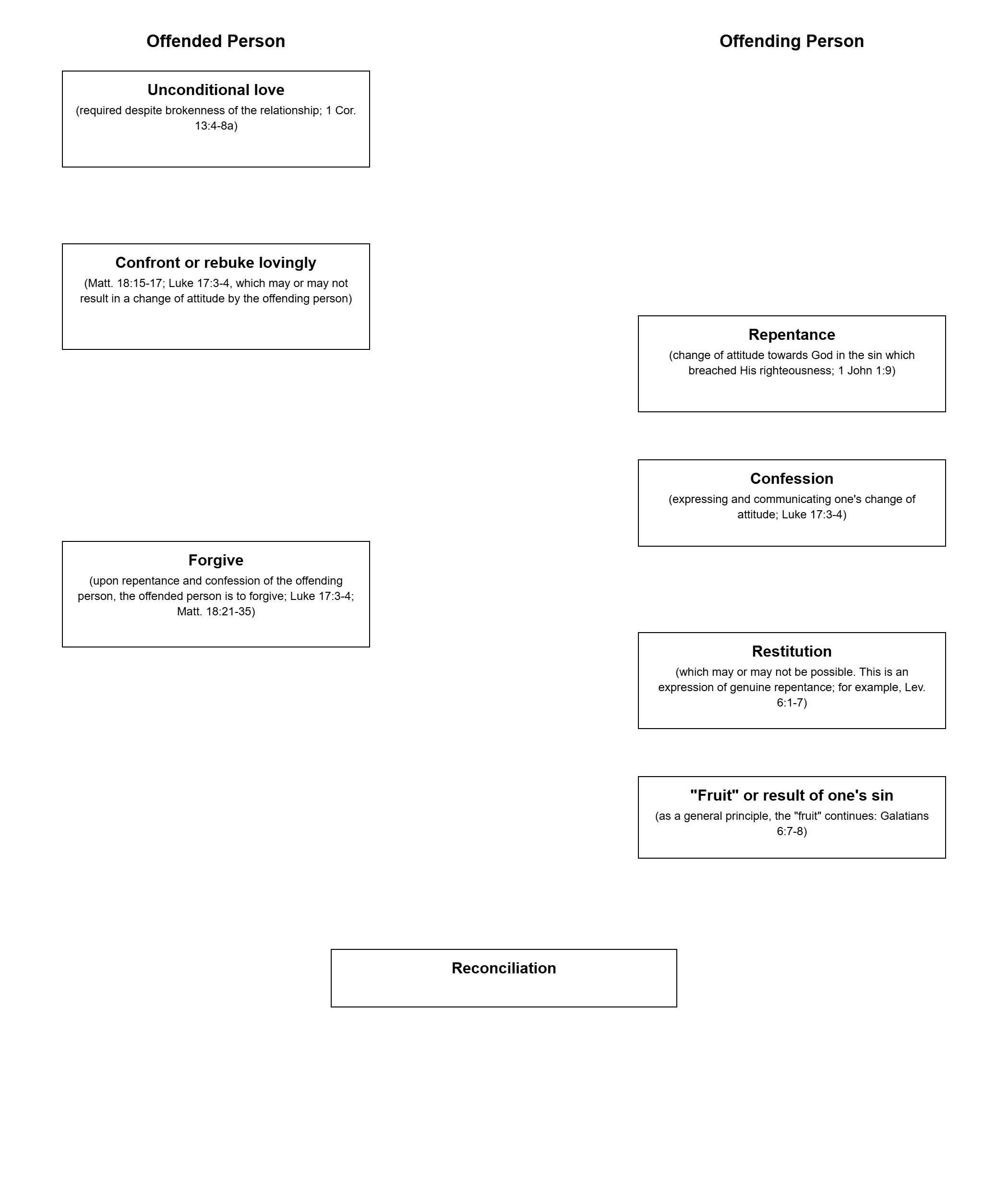
You will see that our ‘map’ on forgiveness (below) has two columns – one plots the general course for the offended person; the other plots the general course for the offended person. Brief comments and supporting biblical texts are also provided. It is basic, but enough to give you a sense of the general ‘lay of the land’ as you engage with your journey of forgiveness.
4. The map is not the journey.
Studying a map and choosing a wise route is not the same as walking that route. The journey itself entails cost and effort, disappointments and encouragements, pain and delight, dreariness and discovery, failures and successes. These are experiences you do not find written on a map.
Hopefully, your actual journey will also include the joy and peace of reaching the destination.
Let’s take a look at the ‘map.’
The ‘map’ of forgiveness
As mentioned, our map is basic and will give you some of the main features of the terrain through which we travel in the process of forgiveness. There is much more to be said about the theology and practice of forgiveness at each step. We will fill in more details later.
The order from the broken relationship to the desired destination of reconciliation starts at the top and moves downward. The main actions of the offended party are on the left, and the offending party on the right. If you want, you can use the link below to download this ‘map.’
Here it is:
 Some first steps
This ‘map’ may leave you with questions or concerns. Be patient—we will explore each of these features in future posts.
For now, here are a couple of initial steps you can take, especially if you are experiencing a broken or damaged relationship.
Where are you?
Until you know where you are on the map, you do not know what direction you should take to reach your destination.
As you consider your situation, ask yourself whether you are the offended person or the offending person. Perhaps you conclude it is some of both. In that case, begin with the offences for which you are responsible.
What is your next step?
Once you know where you are on this ‘map,’ take the next step toward the destination of reconciliation.
If you are not sure what that step is, keep reading this series as we explore it step by step. You are also free to write me if your questions are not answered, or if your course is not clear to you. You can use this link to contact me.
FORWARD TO the next post in this series
BACK TO What Is the Desired Goal of Forgiveness?
TO START at the beginning of this series
Notes:
[1] Letter to Naomi Mitchison (25 April 1954), published in The Letters of J.R.R. Tolkien edited by Humphrey Carpenter with Christopher Tolkien (Boston, MA; Houghton Mifflin Harcourt, 2014), 177.
Image credit: Visualhunt.com
Click "yes" to receive resource-rich newsletters.
Helpful resources provided to 'living theology' subscribers.
YES!