But what about ...


Forgive us our debts, as we also have forgiven our debtors.
(Matthew 6:12)
What does this mean for forgiveness?
A moment’s thought raises two questions:
- Must we forgive “our debtors,” no matter what?
- Is God’s forgiveness of our “debts” conditional upon our forgiveness of “our debtors”?
Before responding, here is a parable that teaches an important principle of interpretation—the first of two principles we will introduce.
The blind men and the elephant
I recall a discussion on forgiveness with a person who viewed Matthew 6:12, 14–15 as the sole lens through which to understand the entire theology and practice of forgiveness. Claiming simplicity and clarity, he subjected everything to this one text, resulting in interpretive blindness.
You likely know the ancient Indian parable of first contact between six blind men and an elephant. Here is the link to an expanded version of this story.
Here is the gist of the parable.
Each man encounters a different part: the side feels like a wall, the tusk like a spear, the leg a tree, the ear a fan, the trunk a snake, and the tail a rope. In the resulting exchange of ideas, the blind men had no idea what the elephant was.

What do we learn for interpreting our text?
The blind men were not aware of the whole; each knew only a part. Limiting understanding to one part led them not only to be confused but also wrong about the whole. So it is with forgiveness: a part is not the whole. We need an appreciation for the whole (the “elephant”) to understand how the parts are connected and work together.
Now, let’s apply this principle to our two questions.
#1: Must we forgive “our debtors,” no matter what?
Here’s the text of Matthew 6:12, 14–15:
“Forgive us our debts, as we also have forgiven our debtors … For if you forgive [others] when they sin against you, your heavenly Father will also forgive you. But if you do not forgive others their sins, your Father will not forgive your sins.”
Some argue we must forgive others no matter what—no need for repentance or confession by the offender; only unilateral, unconditional forgiveness is required from the person sinned against. To reinforce this point, they note the text mentions forgiveness, not repentance or confession.
Others claim that because this refers to “debtors,” it is restricted to financial obligations.
Let’s look more closely at the text.
First, while 6:12 uses “debts” and “debtors,” the parallel text of Luke 11:4 states:
“Forgive us our sins, for we also forgive everyone who sins against us.”
Furthermore, the explanatory verses (Matthew 6:14-15) use the Greek paraptōma, rendered as trespass, transgression, wrongdoing, or sin. This is far beyond finance.
You might ask why Matthew inserts “debts” (opheilēma) and “debtors” (opheiletēs) in 6:12. We will return to this significant issue when we respond to our second question.
Second, “Forgive us our debts” is a request that reveals the petitioner’s need for forgiveness, which implies awareness of:
- an offense causing relational damage,
- guilt for that offense, and
- a change of mind and attitude about the offense (repentance).
Although the focus is on obtaining forgiveness, we cannot ignore that this request is only one part of the whole process of forgiveness.
For further confirmation that unilateral or unconditional forgiveness is neither biblical nor therapeutic, see: “Why to Steer Clear of Forgiveness Distortions.”
#2: Is God’s forgiveness of our “debts” conditional on our forgiveness of “our debtors”?
Once again, let’s hear the text (6:12, 14–15):
“Forgive us our debts, as we also have forgiven our debtors … For if you forgive [others] when they sin against you, your heavenly Father will also forgive you. But if you do not forgive others their sins, your Father will not forgive your sins.”
Viewed in isolation, 6:12, 14–15 seems to make God’s forgiveness conditional on our forgiveness of others.
We might ask:
“Is God’s forgiveness of my sins contingent on my forgiving those who have offended me?”
This challenge is not new. Through the centuries, theologians have wrestled with it—Tertullian, Chrysostom, Augustine, Thomas Aquinas, John Calvin, and many others.
Within the limits of this post, here are three responses:
1) Understand the part in the context of the whole
Matthew 6:14-15 indicates we need God’s forgiveness. The verses do not spell out the process, which includes acknowledging and expressing our wrong and requesting forgiveness (i.e., repentance and confession). These verses do address the result of our response to that implied process: we forgive the offender. So, tread cautiously. Do not impose on these verses the whole theology and practice of forgiveness; receive them as a vital part of it.
2) Understand the unclear in light of the clear
This principle presumes the internal consistency of Scripture—that is, there are no genuine contradictions. Decades of reading and study have confirmed this presumption for me. Apply the principle by interpreting unclear, puzzling texts in light of clear, specific ones.
Two explicit texts on forgiveness (Ephesians 4:32; Colossians 3:13, within their contexts) teach:
Be kind to one another, tenderhearted, forgiving one another, as God in Christ forgave you.
and
… bearing with one another and … forgiving each other; as the Lord has forgiven you, so you also must forgive.
Both are straightforward: God in Christ forgives offending humans—a forgiveness extended in love and received by a repentant offender. Therefore, we must understand the petition in Matthew 6:12, 14–15 in light of such clarity. (See: “Reclaiming Forgiveness: A Fresh Beginning.”)
3) The parable of the unforgiving servant (18:21–35)
Peter asks,
“Lord, how many times shall I forgive my brother when he sins against me? Up to seven times?”
Jesus responds with a parable: Matthew 18:21-35. Take a moment to read it afresh.
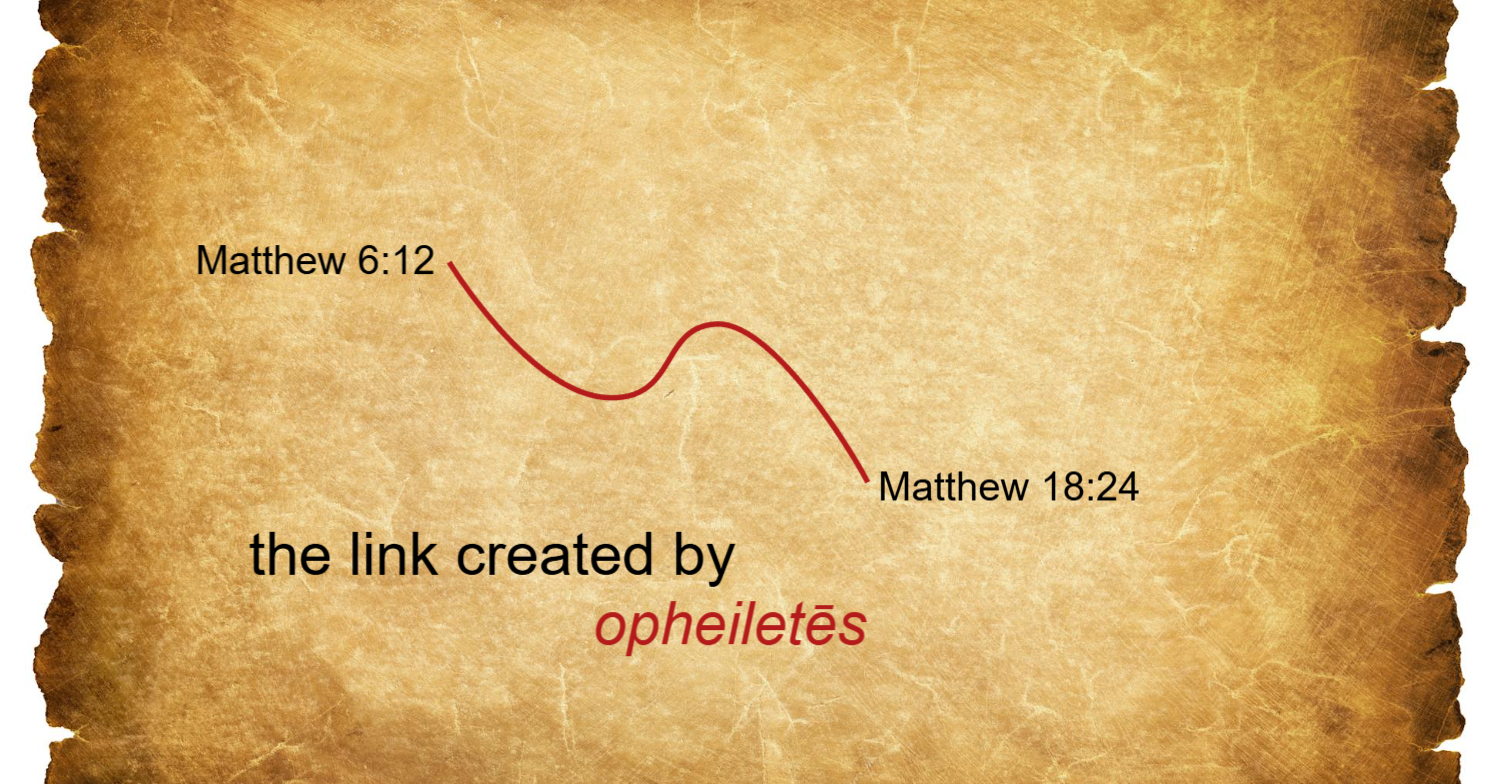
Earlier, we noted Matthew’s choice of “debtors” (opheiletēs) in 6:12, while 6:14–15 and Luke 11:4 use terms translated “trespass” or “sin.” Why “debtors”?
Significantly, Matthew uses opheiletēs only twice—6:12 and 18:24:
“As he [the king] began the settlement, a man who owed (opheiletēs) him ten thousand talents was brought to him.”
Ten thousand talents was a colossal debt. The man falls on his knees and begs for time. The king takes pity, cancels the debt, and lets him go.
That forgiven servant then refuses mercy to a fellow servant who owes a relatively small amount, though the fellow servant also falls on his knees and begs for time. Hearing of this, the king imprisons the unforgiving servant until he has made repayment in full.
In 18:35, Jesus distills the lesson:
“This is how my heavenly Father will treat each of you unless you forgive your brother from your heart.”
How does this parable illuminate the Lord’s Prayer?
- The king (God) initiates the process; it is not conditional on the servant forgiving first.
- The first servant’s posture and plea to the king encapsulate repentance—acknowledgement, humility, and request.
- The second servant’s plea likewise manifests repentance—in fact, the words both servants used are virtually identical (18:26, 29).
- The first servant refuses to forgive, despite having been forgiven by the king.
- The parable, therefore, illustrates the petition of the Lord’s Prayer: forgiven people are to forgive.
Matthew’s distinctive link between 6:12 and 18:21–35 clarifies the prayer’s petition. Our forgiveness of others is not a condition of God’s forgiveness. Instead, our forgiveness of others is to manifest that we know God’s forgiveness.
A disciple’s forgiveness of others is the proof of their heart posture: we forgive as we have been forgiven.
Summing up
In general terms, the Lord’s Prayer expresses a disciple’s desire to forgive others as God has forgiven them; that their heart is aligned with the King, not the unmerciful servant.
The emphasis is not that human forgiveness earns God’s forgiveness, but that human forgiveness flows from God’s forgiveness.
Two modern scholars offer helpful guidance.
Michael Wilkins states:
This does not teach that humans must forgive others before they can receive forgiveness themselves; rather, forgiveness of others is proof that that disciple’s sins are forgiven and he or she possesses salvation (cf. 18:21–35). Disciples are to forgive those who have wronged them to maintain a joyful experience of our salvation (cf. 6:14–15). Doing so serves as evidence that a person has truly been forgiven his or her debt of sin. If we don’t forgive, it is evidence that we haven’t experienced forgiveness ourselves.[1]
John Nolland adds something of a cautionary note:
Though God prefers the coinage of mercy, he will deal with us in the coinage with which we have chosen to deal with others.[2]
In the next post, we will explore the Lord’s words on the cross: “Father, forgive them …”
If you have comments or questions on this post—or other troubling texts you would like considered—please contact me using this link.
FORWARD TO the next post in this series
BACK TO A Map to Guide You to Forgiveness
TO START at the beginning of the series
Notes:
[1] Michael J. Wilkins, Matthew, NIVAC (Grand Rapids, MI: Zondervan, 2004), 279. Emphasis added.
[2] John Nolland, The Gospel of Matthew, NIGNTC (Grand Rapids, MI/Bletchley, UK: Eerdmans/Paternoster, 2005), 291.
Image credit: “Parable of the Unforgiving Servant” by Nikola Sarić. You can visit his website using this link.
Click "yes" to receive resource-rich newsletters.
Helpful resources provided to 'living theology' subscribers.
YES!