I call it heresy!

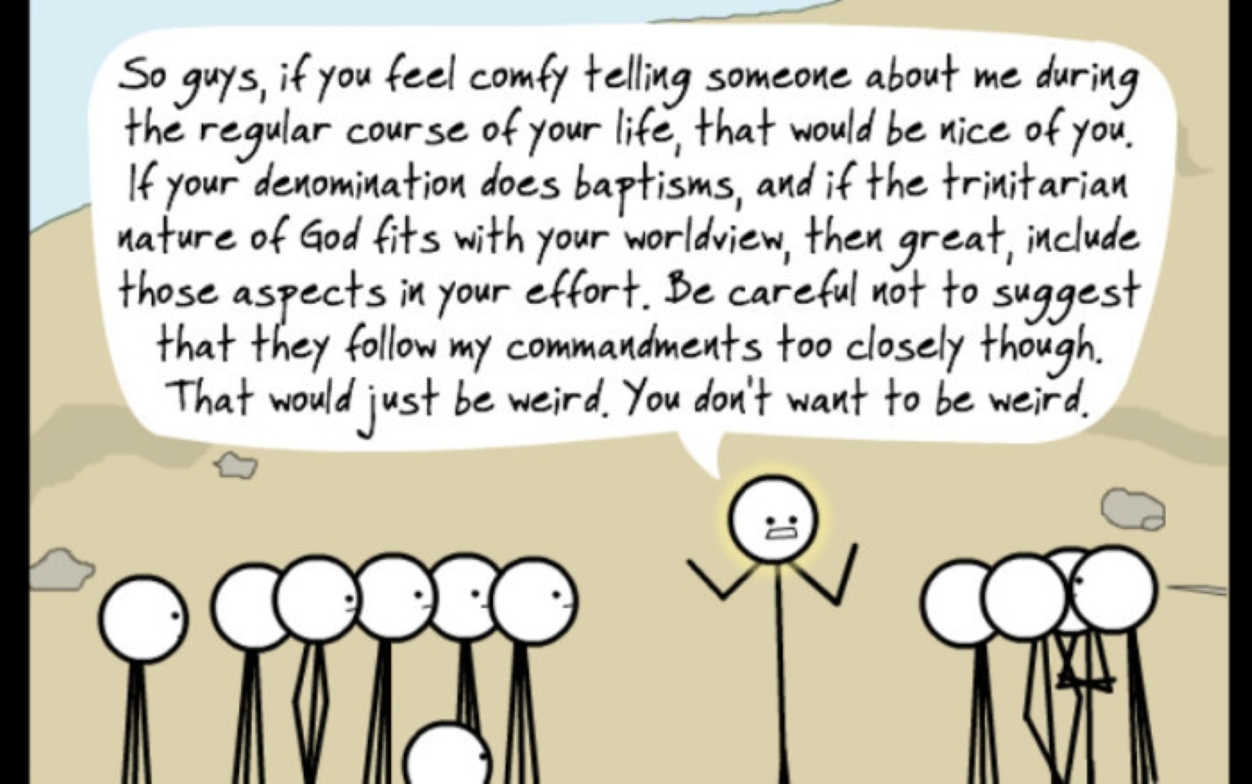
What is this heresy?
What can we do about it?
A notable heresy
A. W. Tozer writes in I Call It Heresy!:[1]
… a notable heresy has come into being throughout our evangelical Christian circles – the widely-accepted concept that we humans can choose to accept Christ only because we need Him as Saviour and that we have the right to postpone our obedience to Him as Lord as long as we want to!
After more than 50 years of Christ-life, I continue to be amazed at the prevalence of this thinking among those who profess to be Christians. For instance, a person can say a “sinner’s prayer” and continue living their life without any change. Nothing in their life manifests a relationship with Jesus Christ.
This is one of the reasons I seldom use the term “Christian.” Although it is a biblical term, it has lost much of its meaning in our culture. Instead, I use the term “follower of Jesus,” because it describes an activity of the soul that expresses itself in life.
Vampire Christians
Dallas Willard comments on this “heresy” in The Great Omission:[2]
This “heresy” has created the impression that it is quite reasonable to be a “vampire Christian.” One in effect says to Jesus, “I’d like a little of your blood, please. But I don’t care to be your student or have your character. In fact, won’t you just excuse me while I get on with my life, and I’ll see you in heaven.” But can we really imagine that this is an approach that Jesus finds acceptable?
We may be uncomfortable with Willard’s graphic description – “vampire Christian” – but is he wrong?
Cheap grace
In The Cost of Discipleship, Dietrich Bonhoeffer identifies this heresy as “cheap grace.” This “amounts to the justification of sin without the justification of the repentant sinner who departs from sin and from whom sin departs.”[3]
He continues:
Cheap grace is the preaching of forgiveness without requiring repentance, baptism without church discipline, communion without confession, absolution without personal confession. Cheap grace is grace without discipleship, grace without the cross, grace without Jesus Christ, living and incarnate.
“Heresy,” “vampire Christian,” “cheap grace” – three ways of describing a condition that presumes it is Christian, but is not.
Where do you stand?
What God desires
God’s great purpose and goal for each of us is that we be conformed to the image of his Son, Jesus Christ (see Romans 8:28-29; 1 John 3:2-3; 2 Corinthians 3:18). This process of transformation is discipleship.
Jesus commissioned the eleven—and by extension, you and me—with these words (Matthew 28:18-20):
“All authority in heaven and earth has been given to me. Therefore go and make disciples of all nations, baptizing them in the name of the Father and of the Son and of the Holy Spirit, and teaching them to obey everything I have commanded you. And surely I am with you always, to the very end of the age.”
“Make disciples” is the verb or action word in this, the Great Commission, instructing us what we are to be doing; “go,” “baptizing,” and “teaching” are the related participles, instructing us how we are to accomplish this grace-filled work. For more details, you can watch my video, “Introducing You to the Great Commission”(16:06).
Is this pie-in-the-sky idealism, or is it being realized? As evidence that this theology is living, I have had the privilege of teaching numerous groups of enthusiastic followers of Jesus. Jesus Christ and His Great Commission have been at the center of our discussions and prayers.
How do we go about fulfilling and living this command of our Lord?
Moving forward
Willard observes:[4]
… I know of no current denomination or local congregation that has a concrete plan and practice for teaching people to do ‘all things whatsoever I have commanded you.’ Very few even regard this as something we should actually try to do, and many think it to be simply impossible.
So, what can we do?
My proposal
Matthew, in his Gospel account, has provided us with a paradigm for making disciples. We simply need to reclaim that paradigm and begin to live it as communities of God’s people.
In the weeks to come, we will periodically examine ways in which we can read Matthew’s Gospel more “thickly,” discern what it means in our time and place, and live it out in God-honoring ways.
Let me know if you have any questions or comments. You can reach me via this link.
FORWARD TO the next post in this series
Notes:
[1] A. W. Tozer, “I Call It Heresy!” in Twelve Sermons in Peter’s First Epistle (Harrisburg, PA: Christian Publications, 1974), 9-10.
[2] Dallas Willard, “Why Bother with Discipleship?” in The Great Omission: Reclaiming Jesus’s Essential Teachings on Discipleship (New York, NY: HarperOne, 2006), 14.
[3] Dietrich Bonhoeffer, The Cost of Discipleship, rev’d (New York, NY: MacMillan, 1963), 47.
[4] Dallas Willard, “Spiritual Formation in Christ,” in The Great Omission: Reclaiming Jesus’s Essential Teachings on Discipleship (New York, NY: HarperOne, 2006), 72-73.
Image credit: Adam4d.com (http://adam4d.com/matthew-2819-20-american-popular-version/). Link no longer available.
Click "yes" to receive resource-rich newsletters.
Helpful resources provided to 'living theology' subscribers.
YES!