What Is a Relationship Breaking Point?


If forgiveness is the process of rebuilding damaged or broken relationships, what damages or breaks a relationship?
How can we identify a genuine breaking point?
You might ask, “Why do you say, ‘a genuine breaking point?’ Are there some that are not genuine?”
To which I answer, “Yes, and we will come to those later.”
So, in the next three posts, we will explore three crucial issues:
- Genuine breaking points,
- An overlooked breaking point, and
- Spurious ‘breaking points’ in contrast.
We begin with genuine breaking points, by which I mean issues that require a person to enter the process of forgiveness to rebuild that relationship.
Some breaking points are obvious, others not so much. Here are a few scenarios to get you thinking.
What do you think?
What do you think about the following:
- You accidentally bump into a stranger on a crowded bus. Have you damaged or broken a relationship?
- A friend misunderstands something you said and disagrees with you. Is your relationship damaged or broken?
To each of these, you probably say, “No.”
I agree.
Each of these is a minor issue. A simple “excuse me” or “sorry” will suffice on a bus. “My apology, I thought you meant ….” clears up any misunderstanding. The relationships remain unchanged, so there is nothing damaged or broken. There is no need here to rebuild a relationship; no need to forgive or be forgiven.
Now let’s add a couple of twists.
- What if you steal the stranger’s wallet as you bump into him?
- What if your friend gets angry with you and calls you a liar?
“Ah, that’s different,” you say.
I agree. But why and how is it different?
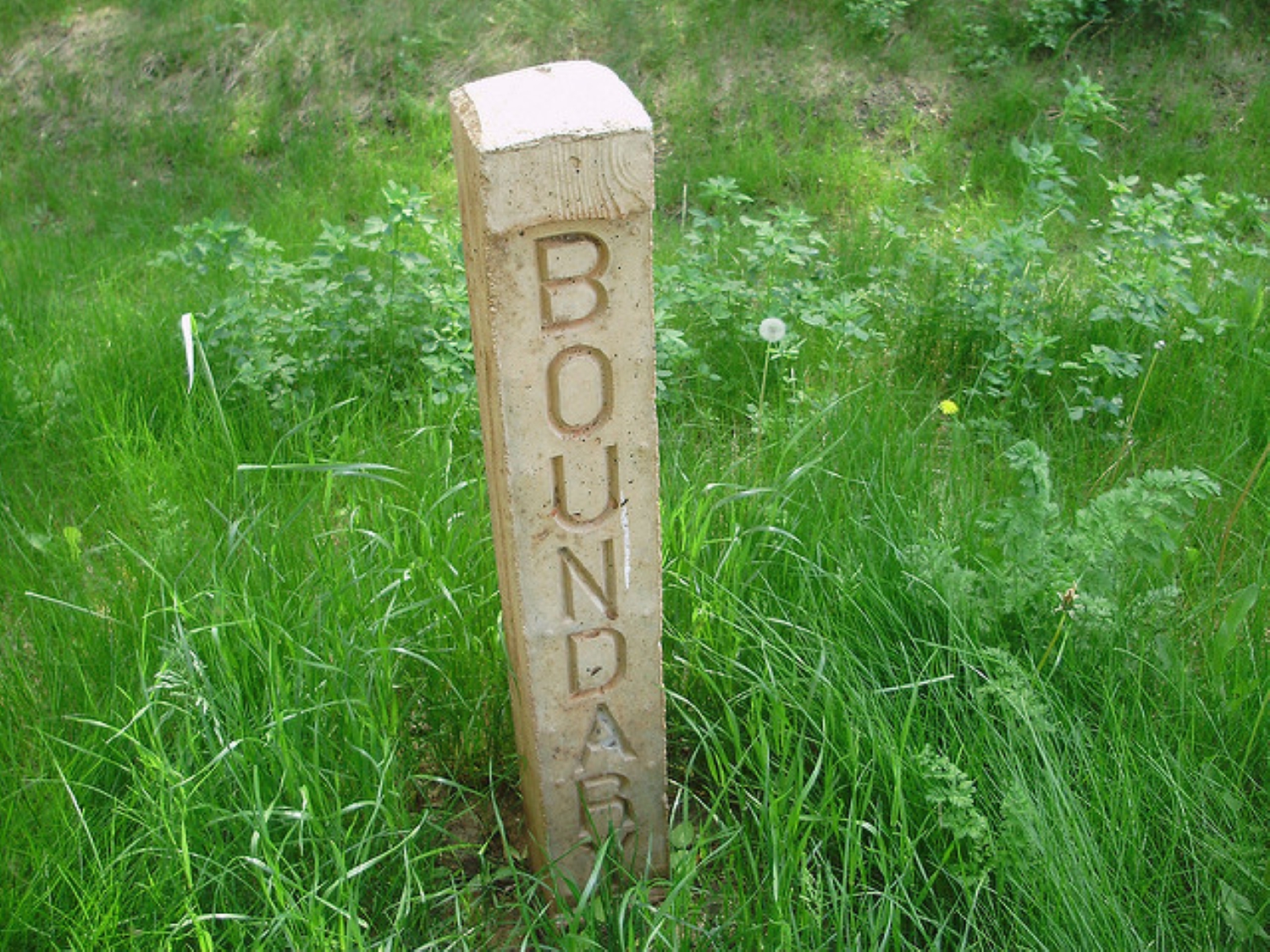
Let’s begin with boundaries – relational boundaries.
What is a relational boundary?
Every relationship has one or more boundaries that define its existence and integrity. What we are calling a ‘breaking point’ is the point at which we step over or transgress such a boundary, thereby damaging or destroying that relationship.
It began with God. He defined his relationship with Adam with a clear and simple boundary (Genesis 2:16-17):
“You are free to eat from any tree in the garden; but you must not eat from the tree of the knowledge of good and evil, for when you eat of it you will surely die.”
God is extravagantly generous: “You are free to eat from any tree in the garden.” Yet he reserved something for himself alone, which became a boundary that marked the existence and integrity of the relationship between humans and the Creator. The human was human, not God; a creature, not the Creator.
Later, we read that Adam “ate it” (Genesis 3:6). By taking the one thing reserved exclusively for God, Adam transgressed or ‘stepped over’ that relational boundary, thereby breaking his relationship with God.
Adam had been forewarned of the consequences: “when you eat of it you will surely die.” (2:17)
Those consequences are demonstrated by Adam’s responses to God (3:6-24), including:
- guilt,
- shame, and
- fear.
Did God cease to love Adam—that is to say, humanity?
No.
Was forgiveness required to rebuild what had been broken?
Yes.
Another example
Here is an example from interpersonal human relationships.
The relationship of marriage has a boundary of exclusive sexual intimacy. The husband is exclusively for his wife; the wife is exclusively for her husband (Genesis 2:24-25; Mark 10: 6-9; 1 Corinthians 7:4-5). One spouse’s sexual intimacy with anyone other than their spouse is stepping over a boundary that defines the existence and integrity of that marriage relationship. The result is a damaged, possibly broken, marriage.
How do we identify these relational boundaries?
‘Where’ are these relational boundaries?
When I ask ‘where’ these relational boundaries are, I am simply asking how we identify them.
A fundamental starting point for locating relational boundaries is the Ten Commandments (Exodus 20:1-17; Deuteronomy 5:6-21).
One of these boundaries is “You shall not steal.” So, if you pick the pocket of a stranger and take his wallet, you have crossed a relational boundary.
By the way, six relational breaking points are:
- Not honoring your father and mother;
- Murder;
- Adultery;
- Stealing; and
- Lies about your ‘neighbor.’
- Coveting your ‘neighbor’s possessions’ – and that includes their house, spouse, employees, donkeys, cars, and so forth.
Jesus defined these relational boundaries with even greater depth, reaching into our hearts and minds, and into their thoughts, motives, and attitudes (Matthew 5-7).
Here is what Jesus says about your angry friend who calls you a liar – or maybe it was you who spoke in anger to your friend (Matthew 5:21-23):
“You have heard that it was said to the people long ago, ‘Do not murder, and anyone who murders will be subject to judgment.’ But I tell you that anyone who is angry with his brother … anyone who says to his brother, [‘you good-for-nothing’] … anyone who says, ‘You fool!’ … .”
So relational boundaries between humans are located at these six places. Those six relational breaking points are not measured only in actions and words, but also in thoughts and attitudes such as anger, lust, and envy. After all, such thoughts and attitudes have a way of alienating affections toward others and expressing themselves in words and actions.
You might ask, “What do I do with unspoken thoughts and attitudes? Do I need to confess those?”
We will deal with these and other questions later.
Reflections
Together, we will walk through each step of the map to guide you to forgiveness. For now, here are two matters for reflection:
- Now that you have an idea what relational boundaries are and where some of them are located, ask yourself whether you have stepped over the line with someone. Take a moment to write down that person’s name and something about the incident—maybe you do not even need to write it down. Put your note in a private place for later reference.
- Perhaps someone has stepped over the line with you. Just like the previous paragraph, make a note of that and tuck it away where only you will see it.
We have raised several issues in this post that warrant further exploration. In the next post, we will explore an overlooked breaking point.
If you have any questions or comments about this post, please write to me using this link.
FORWARD TO the next post in this series
BACK TO Another “But What About …”
TO START at the beginning of this series
Image credits: (1) Fraying rope: Depositphotos.com; (2) Boundary marker: ank0ku via Visualhunt.com / CC BY-NC
Click "yes" to receive resource-rich newsletters.
Helpful resources provided to 'living theology' subscribers.
YES!