Another “But What About …”

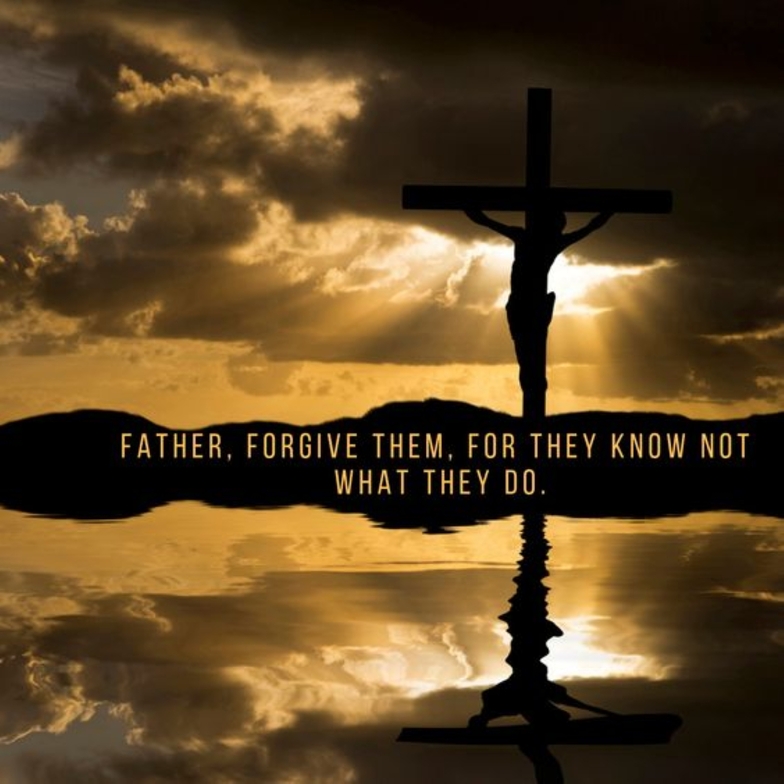
Father, forgive them, for they do not know what they are doing.
(Luke 23:34)
Some time ago, I was asked,
“But what about when Jesus says, ‘forgive them’? Doesn’t that mean we have to forgive everyone without condition?”
Good question.
The phrase “forgive them” is taken from the Gospel according to Luke, the first of Luke’s two volumes in the Bible. Here is what he records (Luke 23:33-34):
When they came to the place called the Skull, there they crucified [Jesus], along with the criminals – one on his right, the other on his left. Jesus said, “Father, forgive them, for they do not know what they are doing.”
It is essential to understand a text within its context. So, please take a moment to read this scene of Jesus’ crucifixion (Luke 23:32-43).
Now that you have read Luke’s report, here are five questions we need to answer to discover what his words really mean.
Question #1: To whom was Jesus speaking?
The words that Jesus spoke are clear enough:
“Father, … .”
Although others heard, he was not speaking to them.
Let me press this question a little more. Perhaps it is better to ask,
“What was the nature of the words that Jesus spoke?”
This is a request that the Lord Jesus addressed to his Father. That request is formed as a prayer:
“Father, forgive them ... .”
This is a prayer that others may be forgiven, not an incident of others being forgiven.
So, Jesus was praying to his Father.
Question #2: About whom was Jesus speaking?
In the context, we notice that “the people stood watching ... the [religious] rulers sneered at him ... the [Roman] soldiers mocked him ... one of the criminals who hung there hurled insults at him ...” (see generally Luke 23:26-43).
Not everyone is present, but everyone is represented:
- watching people,
- sneering Jewish rulers,
- mocking Gentile soldiers, and
- a criminal hurling insults.
Was Jesus speaking about the few dozen, or perhaps few hundred people within the range of his voice? Was he speaking in wider terms of all the people gathered in Jerusalem at that time? Or did he have every human being on his mind and heart—even you and me?
No doubt, he is speaking about those around the cross. And yet, I am inclined to the view that we are all represented in that crowd—Jew and Gentile, enslaved and free, male and female—every person, whenever and wherever we live.
It is Jesus’ prayer for those complicit in his crucifixion—and by extension, you and me.
Question #3: What did Jesus say?
Here is the text of Luke 23:34:
“Father, forgive them, for they do not know what they are doing.” And they divided up his clothes by casting lots.
His words are the language of a prayer request, followed by a simple observation of those gambling for his discarded clothes.
The contrast could not be starker. His words express his selfless love for his persecutors. The act of gambling for his clothing manifests the callous hearts of those surrounding the cross.
His words give us a glimpse of his heart as he manifests his love for his enemies and tormentors so that they may experience forgiveness.
Significantly, the Lord Jesus does not say:
“I forgive you.”
This raises another critical question.
Question #4: Can Jesus forgive sins?
We need to answer this question.
If Jesus could forgive sins, why did he not simply say to the crowd, “I forgive you”?
Earlier, Luke records an incident in which a paralyzed man is carried to Jesus in a crowded house. To bring their paralyzed friend to Jesus, those carrying the man climb up, dismantle part of the roof, and lower him through the opening (Luke 5:17-26).
When Jesus saw their faith, he said, “Friend, your sins are forgiven.”
The Pharisees and teachers of the law challenged his words:
“Who is this fellow who speaks blasphemy? Who can forgive sins but God alone?”
Jesus responds (5:23-25):
“Which is easier: to say, ‘Your sins are forgiven,’ or to say, ‘Get up and walk’? But that you may know that the Son of Man has authority on earth to forgive sins...”
By my understanding, it is easier to say, “Your sins are forgiven.” After all, who would see or know the difference? Jesus speaks words that immediately show his power and authority.
He said to the paralyzed man, “I tell you, get up, take your mat and go home.”
Immediately he stood up in front of them, took what he had been lying on and went home praising God.
Jesus has the power to forgive sins. He did so for a paralyzed man who came with a heart yearning for wholeness.
If Jesus can forgive sins, why didn’t he do that from the cross?
Instead, he prays, “Father, forgive them, for they do not know what they are doing.”
Question #5: Is Jesus’ prayer answered?
If so, how and when?
Even amid the animalistic brutality of his crucifixion, Jesus’ love radiates its concern that others be forgiven. How is this prayer answered?
One of the criminals being executed manifests his change of heart toward Jesus (23:39-43): the man confesses his own wrong and acknowledges Jesus as King, saying,
“Jesus, remember me when you come into your kingdom.”
Jesus answers,
“Truly, I say to you, today you will be with me in Paradise.”
The Lord’s words promise full participation in the Kingdom, a promise that implicitly includes forgiveness.
This repentant man is the foretaste of the Father’s answer to Jesus’ prayer.
Luke continues the ‘story’ in his second volume: Acts. In the book of Acts, we read of incident after incident as Jesus’ prayer continues to be answered.
In Acts 2, a large crowd witnesses strange events in Jerusalem on Pentecost, 50 days after the Lord’s resurrection. God is present and at work redeeming his world.
Peter pronounces the guilt of the crowd (2:36):
“Let all the house of Israel therefore know for certain that God has made him both Lord and Christ, this Jesus whom you crucified.”
The people respond (2:37-38):
Now when they heard this, they were cut to the heart and said to Peter and the other apostles, “Brothers, what shall we do?”
And Peter said to them, “Repent and be baptized, every one of you, in the name of Jesus Christ for the forgiveness of your sins.”
What an answer to Jesus’ prayer on the cross – 3,000 people experienced forgiveness and new life that day (2:41)!
Forgiveness is offered through Jesus Christ; forgiveness is received upon a change of heart toward Jesus (repentance).
As we continue reading Acts, we encounter multitudes obtaining forgiveness as their hearts are changed toward Jesus. Examples include:
- a crowd in the Temple (“repent therefore, and turn again, that your sins may be blotted out” – 3:19),
- “a great many priests became obedient to the faith” (6:7),
- the Ethiopian minister of finance (8:26-40),
- a Pharisee named Saul (9:1-19), and
- a Roman army officer named Cornelius (10:34-43),
to name only a few.
And so, Jesus’ prayer continues to be answered throughout history and throughout the world—even now.
This is how God in Christ forgives us.
And this is how we are to forgive one another.
(Ephesians 4:32; Colossians 3:13).
If you have comments or questions on this post—or other troubling texts you would like considered—please contact me using this link.
Click here for an audio version
FORWARD TO the next post in this series
BACK TO But What About ... (Part 1)
TO START at the beginning of this series
Image credit: The source of this image is unknown. If you know its source, please contact this website.
Click "yes" to receive resource-rich newsletters.
Helpful resources provided to 'living theology' subscribers.
YES!