Grace for the Fractures

Kintsugi [/kɪnˈtsuːɡi/];
Japanese: 金継ぎ, lit., ‘golden joinery.’[1]
Can a broken relationship or person ever be whole again?
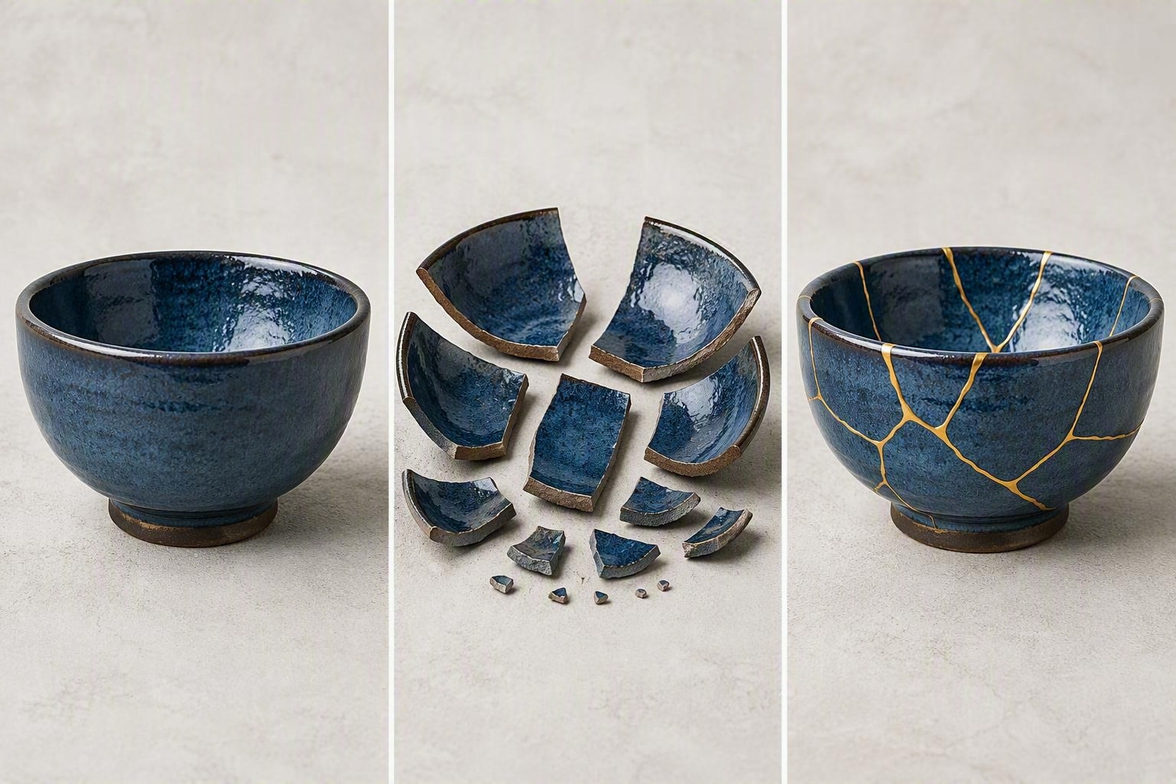
The three images (above) show the same bowl, from its original state to shattered fragments to rebuilt, employing the art form of kintsugi.
A friend of Japanese ancestry introduced me to kintsugi, a painstaking and time-consuming process of rebuilding broken pottery with a special lacquer mixed with gold powder, though other precious metals can be used.
I will use kintsugi as a metaphor for the process of rebuilding a person or a relationship that has been damaged or broken. Keep this metaphor in mind as we explore the following elements.
Since we are picking up this series, “Reclaiming Forgiveness,” after a summer break, this post will also serve as a review and refresher.
Five Elements
Here are five elements or stages that kintsugi illustrates. I am addressing both victims and offenders in this rebuilding process, although my emphasis is on victims. It just so happens that these elements follow an alphabetic sequence: P-Q-R-S-T.
A note: Throughout this series, I have used the term victim to describe the person or group sinned against, and the term offender to describe the person or group who sinned. The process of biblical forgiveness demonstrates that these need not be, and should not be, permanent identities for either.
By God’s grace, the gift of repentance to an offender and the granting of forgiveness by the victim to a repentant offender invite and empower personal and relational transformation. Our identity should neither be defined by victimhood nor offender-hood; our identity is meant to be “in Christ.” (See the series “Being in Christ”)
Now let’s explore five elements of rebuilding what is broken.
P = Pain
The breaking of a valued relationship is painful, yet at a deeper and more personal level, there is the pain, sorrow, and turmoil of betrayal, abandonment, slander, and more.
As God in flesh, our Lord Jesus Christ has experienced such pain. He understands and meets us in the place of fracture.
As you read the psalms, David names his pain before the Lord. He does not deny, bury, or minimize it, nor should we. I encourage you to read his psalms. Here are a few texts to consider from some of those psalms:
I am forgotten by them as though I were dead; I have become like broken pottery. For I hear the slander of many; there is terror on every side; they conspire against me and plot to take my life. (31:12-13)
My friends and companions avoid me because of my wounds; my neighbors stay far away. (38:11)
If an enemy were insulting me, I could endure it; if a foe were raising himself against me, I could hide from him. But it is you, a man like myself, my companion, my close friend, with whom I once enjoyed sweet fellowship as we walked with the throng at the house of God. (55:12-14)
Scorn has broken my heart and has left me helpless; I looked for sympathy, but there was none, for comforters, but I found none. (69:20)
Like the psalmist, take time to acknowledge and identify your pain. As we move forward, we can begin to release the pieces of this fracture into God’s hands.
Q = Questions
In these times of brokenness, we have questions but often struggle to ask them, fearing we may insult our God by doing so. As a result, we tend to bury them and leave them unasked, festering below the surface.
Know that God, who is revealed to us as Jesus Christ, invites our questions. Again, the Psalms offer a rich resource for such questions. Here are a few:
Why, O LORD, do you stand far off? Why do you hide yourself in times of trouble? (10:1; also 44:23-24)
How long, O LORD? Will you forget me forever? How long will you hide your face from me? (13:1; also 6:3; 25:17; 74:10; 89:46)
My God, my God, why have you forsaken me? Why are you so far from saving me, so far from the words of my groaning? (22:1; also 42:9; 43:2)
To these we could add:
- Why did this happen?
- Where were You, and why didn’t You stop it?
- Why does the offender not understand?
- Can I (or this relationship) ever be restored?
My recommendation is to spend time in the lament psalms. Recognize their pattern and make them your own as you ask bold questions. Here are the links to:
“The Blessings of Lament” and
“How Can I Love When It Hurts So Much?”
R = Repentance and Response
For this element, repentance is the offender’s choice, and response is the victim’s decision.
Repentance is a wonderful, grace-filled, life-giving gift that extends to personal and relational wholeness with God, self, and others. This grace-filled gift can be received or refused by an offender.
To learn what repentance is and how it is received and acted upon, begin with “The Word We’d Rather Avoid” and continue with the related posts that follow.
When the offender expresses repentance to the victim, the victim should respond by forgiving. See “Four Qualities of True Forgiveness.”
As we have learned, rebuilding a broken or damaged relationship requires repentance from the offender and the response of forgiveness from the victim. If either of these does not occur, the process of forgiveness is frustrated, and the rebuilding of the relationship cannot proceed.
If the offender is unrepentant, the victim can still experience healing and peace, although the relationship is not rebuilt. See:
“God’s Love is Active for You”
Similarly, if forgiveness is withheld from a repentant offender, there can still be healing and peace for that repentant offender, even if the relationship is not rebuilt. See:
“Why Confession to God Matters”
“When Forgiveness is Withheld”
Even when the relationship is not restored, one’s personal pain can be healed by God’s grace and love where it is fractured.
S = Submission
If you ever try to help a wounded animal, be careful. They may strike out as a means of protection from further pain. It can be the same with us.
When we are in pain, we may strike out or withdraw from the very source that can heal us. Usually, such withdrawal stems from a lack of trust in the other person.
Of course, submission does not mean submitting again to mistreatment, coercion, manipulation, or an unsafe relationship. Rather, it means submitting pain, questions, the right of vengeance, and the desired outcome to God himself.
Once again, the Psalms speak to this issue. Psalm 37 is such a psalm. I recommend you read it prayerfully. Here are a few verses:
Commit your way to the LORD; trust in him and he will do this: He will make your righteousness shine like the dawn, the justice of your cause like the noonday sun. Be still before the LORD and wait patiently for him; do not fret when men succeed in their ways, when they carry out their wicked schemes. (37:5-7)
How did the Lord Jesus respond when abused unjustly? We read in 1 Peter 2:18-25 that “he entrusted himself to him who judges justly.” Here is a link to a practical reflection on that text entitled “Walking in the Way of Christ.”
Determine that you will look to the Lord for his wisdom and grace, and submit to him.
T = Time
The Teacher of Ecclesiastes wrote that there is
a time to tear down and a time to build, … a time to embrace and a time to refrain, … a time to tear and a time to mend, … (3:3, 5, 7)
There is an adage that “time heals all wounds,” but time itself does not heal every wound. As mentioned earlier, the pattern laid out by the lament psalms reveals a healing way forward, and that often takes time.
It often takes time for us to:
- turn to God,
- bring our complaint, naming our wound and its pain,
- ask boldly and give our sorrow a voice,
- choose to submit, entrusting the outcome to God, and
- experience God’s grace for the fracture.
It also takes time to allow the fruit of repentance and rekindled trust to develop into reconciliation. And be aware that sometimes that does not happen.
Allow God’s gracious work, whatever time it takes to work in your life, and the lives of others.
The kintsugi metaphor
Reflecting on our metaphor of kintsugi, we learn that the golden seams reuniting the broken shards of pottery:
- Neither ignore the history of the pottery by concealing the cracks nor glorify the wrong that caused the breakage. The first would deny the injury and pain of brokenness; the other would justify a wrong.
- The act of rebuilding does not allow the brokenness to determine the final form of the pottery.
- Rather, the gold seams magnify the skill and concern of the One who rebuilds broken pottery. The gold traces God’s grace that gathers broken pieces, binds wounds, restores dignity, and creates a future beyond the fractures. This grace does not erase the story; it gives the story a new ending.
This is the kintsugi phenomenon.
More elements could and should be considered. If you have any questions or can add to this post, please feel free to write me using this link.
BACK TO When Restitution Can Never Restore
TO START at the beginning of this series
Notes:
[1] https://en.wikipedia.org/wiki/Kintsugi (accessed June 23, 2026)
Image credit: “Gold in the Fractures” concept and creative design by John B. MacDonald © 2026, using Microsoft Copilot.
Click "yes" to receive resource-rich newsletters.
Helpful resources provided to 'living theology' subscribers.
YES!